
Receiving pushback on an invoice is one of the most challenging aspects of running a business. Whether a client is questioning billed hours, pointing out an unexpected charge, or disputing project scope, handling the situation with professionalism protects both your revenue and your client relationship.
When an invoice dispute arises, swift and structured communication helps de-escalate tension and move the conversation toward a fair resolution.
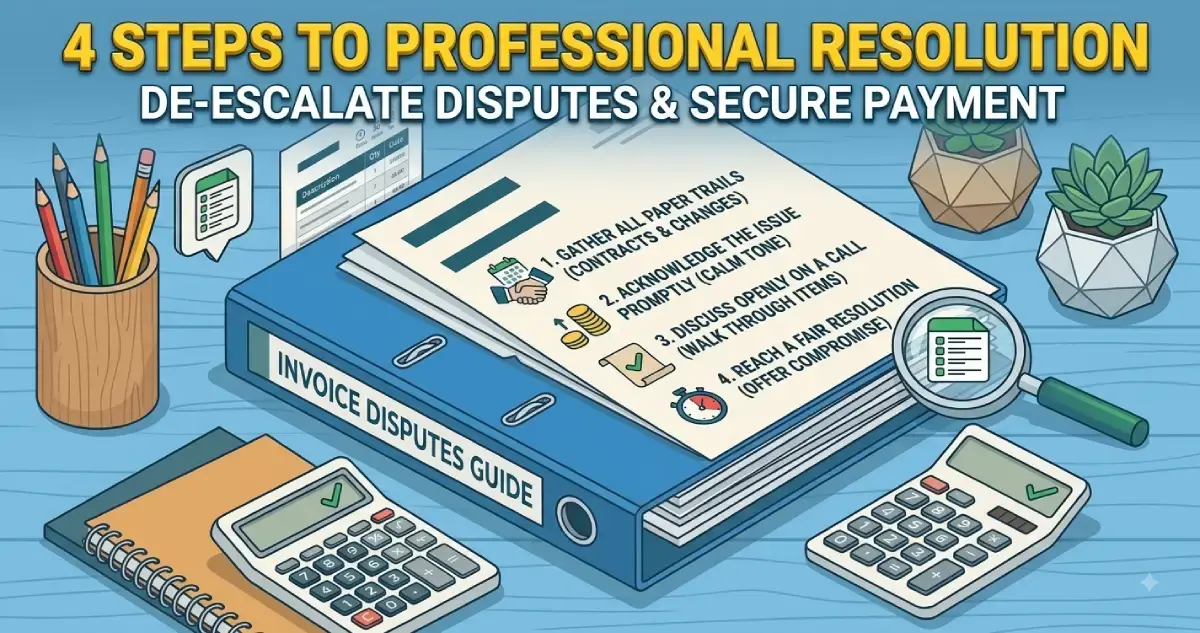
Here is a step-by-step guide to resolving client billing disputes while keeping your professional integrity intact.
1. Common Reasons Clients Dispute Invoices
Understanding why a client is withholding payment helps you tailor your response effectively:
Scope Creep: Additional work was completed without an explicit, pre-approved change order.
Lack of Itemization: Vague summaries (e.g., "Design Services - $3,000") leave room for confusion regarding what was actually delivered.
Unclear Upfront Pricing: The final charge exceeded the original estimate without prior notice.
Unresolved Deliverable Issues: The client feels the delivered work did not meet the agreed quality or functional requirements.
2. A 4-Step Process to De-Escalate Billing Disputes
Step 1: Pause and Review the Paper Trail
Before responding, gather all relevant project documents:
The original signed contract or statement of work (SOW).
Written approval for additional tasks or overages (emails, messages, or change orders).
Time logs, detailed line items, and delivery receipts.
Step 2: Acknowledge the Issue Promptly
Acknowledge the client's concern within 24 hours to show you take their feedback seriously. Keep your initial response neutral, empathetic, and objective.
"Thank you for bringing this to my attention. I've received your note regarding Invoice #1042 and am reviewing the details against our agreed scope. I'll follow up shortly so we can resolve this together."
Step 3: Compare Billed Work Against Agreement
Schedule a brief phone or video call rather than going back and forth via email. Present the documentation clearly:
If the charge is valid: Walk through the written approvals and time logs that support the line item.
If a mistake occurred: Admit the oversight immediately, apologize, and issue an updated invoice.
Step 4: Negotiate a Fair Settlement
If there was a genuine breakdown in communication or an unapproved scope expansion, find a middle ground:
Offer a one-time courtesy discount on the disputed line item while keeping the core balance intact.
Credit the contested amount toward future retainer services.
Establish a brief payment plan if the total bill caught the client off guard financially.
3. Best Practices to Prevent Invoice Disputes Upfront
Always Require Written Change Orders: Never perform work outside the original contract without written confirmation of the extra cost.
Provide Itemized Invoice Breakdowns: List detailed descriptions, hours, rates, or fixed milestone deliverables on every bill.
Set Threshold Warnings for Hourly Projects: Notify clients when you reach 75% and 90% of a estimated budget limit.
Attach Time Logs: Include transparent time-tracking reports with your invoices for hourly billing.
"Avoid misunderstanding by generating clear, itemized invoices using the Full-Screen Invoice Tool."