
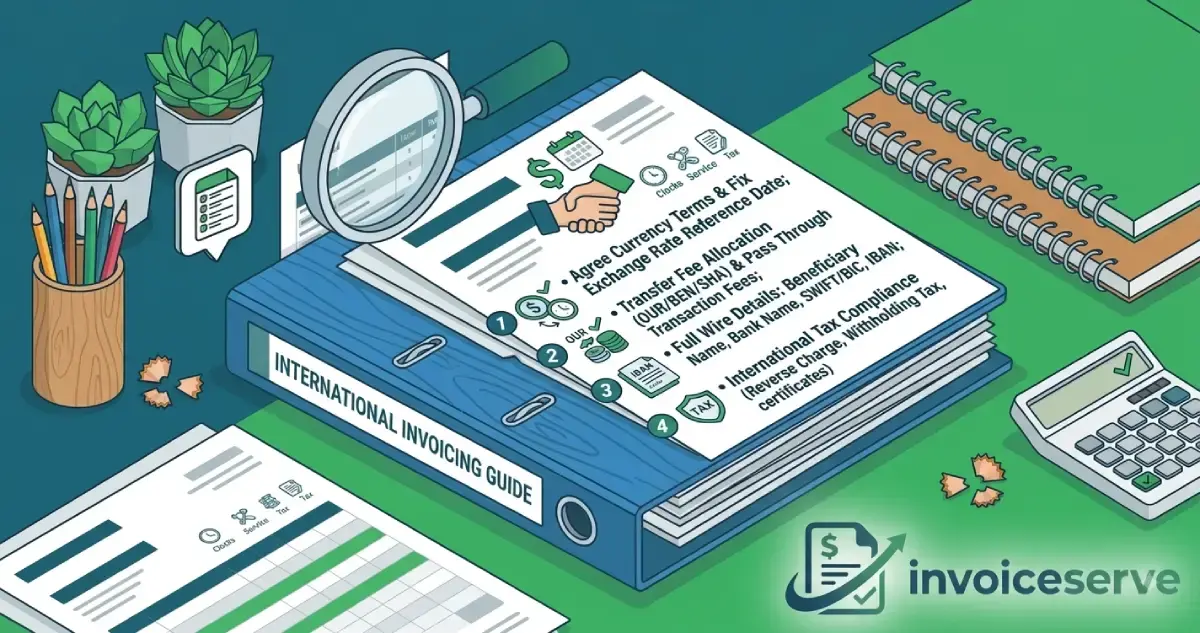
Invoicing international clients opens up broad business opportunities, but it also introduces complexities like fluctuating foreign exchange rates, cross-border banking fees, and international tax compliance. Without clear agreements and proper invoice formatting, cross-border billing can quickly result in unexpected deductions and administrative delays.
Here is a practical guide on how to handle currencies, reduce payment friction, and format international invoices effectively.
1. Establishing Currency Terms and Exchange Rates
Currency fluctuations can significantly impact your profit margins if not addressed upfront in your contract and invoice.
Agree on the Settlement Currency: State explicitly in your agreement whether the invoice will be settled in your local currency (e.g., USD) or the client’s local currency (e.g., EUR, GBP).
Fix the Exchange Rate Reference Date: If you bill in a foreign currency, specify which exchange rate will apply (e.g., "Converted based on the ECB exchange rate on the date of issuance").
Include Dual Currency Summaries: For clarity, display both the foreign transaction currency amount and your local home currency equivalent on the invoice.
2. Managing Cross-Border Banking Fees
International wire transfers (SWIFT) often pass through intermediary banks, each deducting handling fees. This frequently causes invoices to arrive underpaid.
Specify Intermediary Fee Allocation: Use SWIFT fee codes in your payment instructions:
OUR: The buyer pays all transfer fees. (Recommended for sellers)
BEN: The seller pays all transfer fees (deductions come out of the payout).
SHA: Shared transfer fees between buyer and seller.
Pass Through Transaction Fees: Clearly state in your billing terms that the client is responsible for covering all international transfer charges so you receive the full net amount.
3. Essential Banking Details for International Wire Transfers
Standard domestic bank account numbers are often insufficient for global transfers. Every international invoice should clearly list:
Account Holder Name & Physical Address: Exactly as registered with your bank.
Bank Name & SWIFT/BIC Code: The unique identifier for international bank routing.
IBAN / Account Number: International Bank Account Number (required for European and many global transactions).
Intermediary / Correspondent Bank Details: Required if your local bank does not process direct SWIFT transfers.
4. Handling Cross-Border Taxes & Reverse Charges
Tax rules vary depending on whether you are selling physical goods, digital services, or B2B consulting services internationally.
B2B Reverse Charge Mechanism (EU/UK): When invoicing businesses in the EU or UK from outside their tax jurisdiction, you generally do not charge local VAT/GST. Instead, include both parties' Tax IDs and note: "Services subject to the reverse charge mechanism."
Withholding Taxes (WHT): Some foreign jurisdictions require clients to withhold a portion of your invoice payment as tax. Request a tax withholding certificate from your client to claim tax credits in your home country.
"Specify foreign currency symbols and wire transfer details easily on the Free Invoice Generator."